Hydration
Drinking less doesn't change how much waste you need to excrete, only how much water carries it. Urine gets more concentrated and darker.
2.0 → 1.0 L of drinks
- Urine volume1.7 L ↓ 0.7 L
- Osmolality440 ↑ 1068
- Specific gravity1.013 ↑ 1.031
Healthcare
Automatic urine analysis with high throughput, instant results, a lower cost per test and zero consumable waste.
Performance and prevention
From athletes looking for an edge to high-risk populations, anyone can benefit from knowing their metabolic health. Daily monitoring of the byproducts of metabolic breakdown closes the feedback loop between regimen and results.
Because MobileSense needs no test kits or disposables, continuous monitoring doesn't mean continuous waste.
Urine and lifestyle
The kidneys keep blood composition steady by excreting whatever the body doesn't need, so urine chemistry records your day. Each card compares a typical day with one change, using our interactive kidney model.
Drinking less doesn't change how much waste you need to excrete, only how much water carries it. Urine gets more concentrated and darker.
2.0 → 1.0 L of drinks
Nitrogen from protein leaves as urea, the most abundant solute in urine. Protein also adds acid, which lowers urine pH.
1.0 → 2.0 g/kg of protein
The kidneys excrete nearly all the sodium you eat, so urine sodium closely tracks salt intake. That makes it a practical dietary marker.
3.4 → 6.0 g of sodium
Produce is rich in potassium and base-forming salts. More servings raise urine potassium and make urine less acidic.
4 → 9 servings a day
Sweat takes water and salt away before the kidneys see them. Urine volume drops, and the kidneys hold on to sodium.
30 → 90 min of exercise, hot day
Glucose is normally fully reabsorbed. Above about 180 mg/dL the transporters saturate and glucose spills into urine.
95 → 250 mg/dL blood glucose
Typical day: 2 L of drinks, 1 g/kg protein, 3.4 g sodium, 4 servings of produce, 30 minutes of exercise, 70 kg adult with healthy kidneys. Modeled 24-hour values for illustration, not clinical reference data.
SERS uses light to interrogate the fluid: direct optical chemical detection with advantages over other sensing techniques.
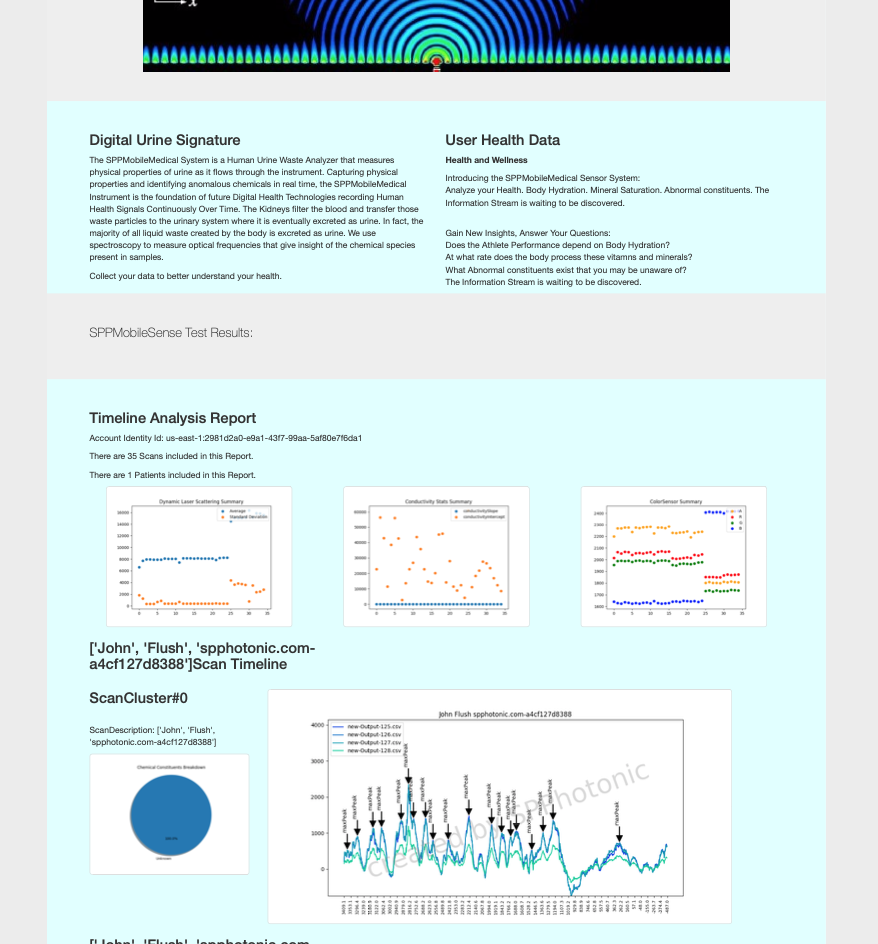
Our software automates data collection, visualizes each capture and produces automated reports for your clients.
Review data and share analysis reports to turn measurements into real insight.
Knowledge base
The constituents of urine can indicate that the body is processing nutrients suboptimally or fighting an infection. Over time, we aim to learn how biomarkers found in urine correlate with health. Selected publications on urine SERS:
MobileSense is a research and monitoring instrument. It is not intended to diagnose, treat or prevent any disease.
Book a demo, ask about licensing, or order the beta platform today.